— 乾燥速度が低下し始める条件を調べた研究 —
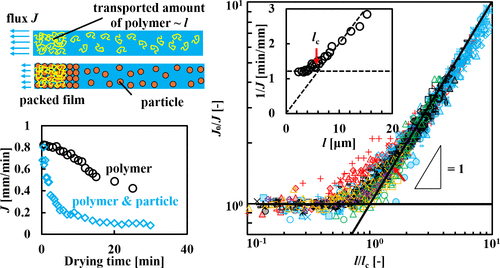
稲澤研究室は、コロイド粒子を含む高分子溶液の乾燥速度が時間とともにどのように変化するかを調べました。高分子溶液に粒子を加えた系は、さまざまな材料で用いられていますが、乾燥速度の時間変化については十分に理解されていませんでした。
🔍 ポイント
1. 乾燥速度が下がり始める条件が見いだされた
乾燥界面に運ばれた高分子の量が、ある臨界値に達すると、乾燥速度が低下し始めることが示されました。
2. 粒子があると、乾燥速度の低下はより早く始まる
コロイド粒子を含む場合、この臨界値はより小さくなり、粒子を含まない高分子溶液よりも、乾燥速度の低下が早く始まりました。
3. 異なる条件の結果が1つの曲線で整理できた
粒子サイズ、高分子の種類、乾燥条件が異なる場合でも、初期乾燥速度と臨界高分子量でスケーリングすると、乾燥速度の時間変化は1本の曲線に重なりました。
🌱 この研究の意義
この研究は、コロイド粒子が高分子溶液の乾燥挙動にどのような影響を与えるかを整理し、乾燥速度低下を考えるための基礎的な見方を与えるものです。高分子と粒子を含む複合液の乾燥挙動を理解するうえで、基礎的な知見として注目されます。
How does the drying rate of polymer solutions change when colloidal particles are added?
— A study on the onset of drying-rate decrease —
Inasawa Lab investigated how the drying rate of polymer solutions changes over time when colloidal particles are present. Although such mixed systems are widely used, their drying kinetics has not been sufficiently studied.
🔍 Key points
1. A condition marking the onset of drying-rate decrease was identified
The drying rate began to decrease when the amount of polymer transported to the drying interface reached a critical threshold.
2. The decrease started earlier in the presence of particles
For polymer solutions containing colloidal particles, this threshold was smaller, meaning that the drying rate started to decrease earlier than in particle-free polymer solutions.
3. Different datasets could be organized on a single curve
After scaling by the initial drying rate and the critical polymer amount, the time evolution of the drying rate under different particle sizes, polymer types, and drying conditions collapsed onto a single curve.
🌱 Why this matters
This study provides a useful framework for discussing how colloidal particles affect drying behavior in polymer solutions. It offers fundamental insight into the decrease in drying rate in polymer–particle mixtures.
JOURNAL ARTICLE: Ind. Eng. Chem. Res. 2025, 64, 22, 10710–10718 doi.org/10.1021/acs.iecr.5c00476
本記事は、公開済み論文のタイトル・要旨等に基づき、学科広報用に編集した紹介文です。This article is an outreach-style summary prepared for the department website based on the published paper title and abstract.