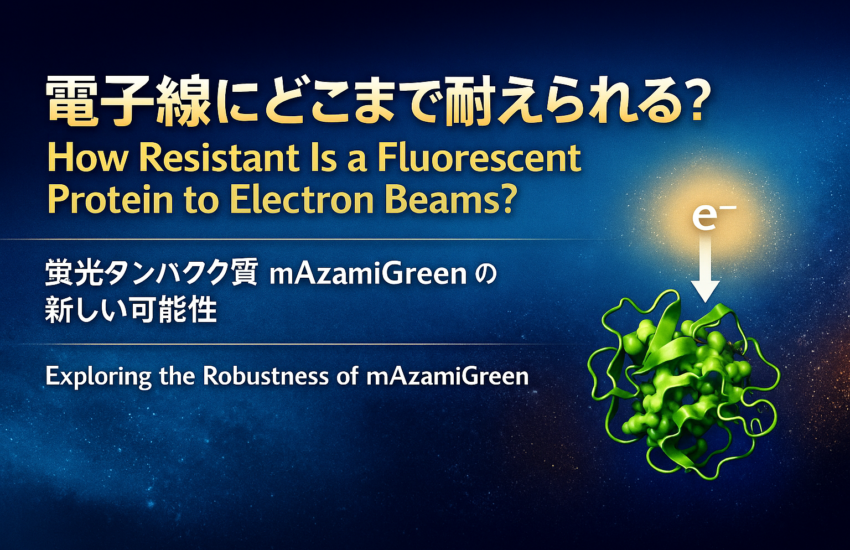
私たちは、生きた細胞の中を「光」で見るために蛍光タンパク質を使っています。一方、電子顕微鏡はとても細かい構造まで見えますが、強い電子線によって蛍光タンパク質が壊れてしまうという問題がありました。この研究では、mAzamiGreen(mAG)という構造が強い蛍光タンパク質に注目しました。その結果、電子線を当てると光は弱くなりますが、mAGはよく使われるEGFP(青色や紫外線の下で緑色に光るタンパク質)より10倍以上も長く耐えることが分かりました。さらに、水の中では分子が少し修復されるため、乾燥状態よりも壊れにくいことも分かりました。この成果は、光と電子を同時に使って細胞を見る新しい顕微鏡技術につながる、大きな一歩です。
🧬 mAzamiGreen はどこまで耐えられる?
GFP (Green fluorescent protein) は、青色や紫外線の下で緑色に光るタンパク質です。本研究では、従来よく研究されてきた EGFP(enhanced GFP: 野生型 GFP の変異体で、GFP に対してより高輝度の発光を示す) よりも構造的に安定とされる蛍光タンパク質mAzamiGreen(mAG) に注目しました。
その結果、電子線照射によって、(1) 蛍光強度は減少する、(2) 発光スペクトルは赤側にシフトする。しかし、mAG は EGFP より1桁以上高い電子線耐性を示すことが明らかになりました。
💡 なぜ耐性が高いのか?
mAG には、発光中心(クロモフォア)とヒスチジン残基の πスタッキング構造という、EGFPにはない特徴があります。この構造が、電子線による分解を受けにくいより“壊れにくい蛍光タンパク質”を実現していると考えられます。
🌱 乾燥状態と溶液中の違い
さらに本研究では、乾燥状態よりも溶液中(水中)のほうがmAG の電子線耐性がやや高いことも分かりました。これは、溶液中では分子が周囲と交換され、構造の“自己修復”が部分的に起きている可能性を示唆しています。
🧬 Why mAzamiGreen?
In this study, Minoda Lab investigated mAzamiGreen (mAG), a fluorescent protein known for its high structural stability, and compared it with the widely used EGFP. Electron‑beam irradiation caused: (1) a decrease in luminescence intensity, and (2) a red shift of the emission peak in both proteins. However, a key finding is that mAG survives electron irradiation more than one order of magnitude better than EGFP.
💡 Origin of the enhanced resistance
mAG possesses a unique π‑stacking interaction between its chromophore and a histidine residue, a feature absent in EGFP. This structural robustness is considered responsible for the slower intensity decay and improved electron‑beam resistance.
💧 Dry vs. wet environments
The experiments further revealed that mAG is slightly more resistant: in solution than in the dry state. This suggests that molecular exchange with the surrounding environment may allow partial structural repair under irradiation.
🚀 Future potential
These results indicate that mAzamiGreen is a promising candidate for: (i) cathodoluminescence‑based correlative microscopy, (ii) multi‑color CL imaging, and (iii) real‑time observation of biological structures at nanometer resolution.
JOURNAL PAPER: Micron
Volume 201, February 2026, 103944
Investigation of electron beam resistance of mAzamiGreen using an electron photon hybrid microscope
Mihiro Suzuki, Toshiki Shimizu, Hiroki Minoda
https://doi.org/10.1016/j.micron.2025.103944
Fluorescent proteins allow scientists to “see” what is happening inside living cells using light. Electron microscopes, on the other hand, can observe extremely fine structures, but strong electron beams often damage fluorescent proteins. In this study, Minoda Lab focused on mAzamiGreen (mAG), a structurally stable fluorescent protein. They found that although electron beams reduce its brightness, mAG survives more than ten times longer than the commonly used EGFP. They also discovered that mAG is slightly more resistant in liquid than in dry conditions, likely because molecules can partially repair their structure. These results open the door to next‑generation microscopes that combine light and electron imaging in real time.
本記事は、公開済み論文に基づき学科広報用に編集した紹介文です。This article is an outreach-style summary prepared for the department website based on the published paper.