From : https://note.com/tuatdaizukan/n/n09dc9f563037
量子物理学の“不思議”を精密計測技術へ — スピン研究の最前線
畠山 温 教授は、「量子の世界(原子・電子などの極めて小さなミクロ領域)」で起きる現象を探究し、
特に “スピン” と呼ばれる粒子の性質を用いた新しい分析・計測技術の開発に取り組んでいます。
◆ スピンとは?高校生にもわかるやさしい説明
電子や原子のような小さな「粒子」は、“スピン”という固有の性質(小さな磁石のような力) を持っています。
- スピンは止まらず、常に粒子が持つ“生まれながらの特徴”
- スピンを調べることで、「どんな”粒子”なのか」「どんな状態にあるのか」 を知ることができる
- 多くの”粒子”のスピンが揃うと、私たちが知る“磁石”の性質として現れる
つまり、スピンは物質の性質そのものを決める鍵ともいえる重要な情報です。
◆ 研究内容:スピンを使った“超高感度”分析技術へ
スピンを精密に観測できれば、ごく微量の物質を識別したり、状態を高感度に読み取る新しい分析手法が実現できます。しかし、課題は「スピンの信号はとても弱い」こと。通常は大量の物質がないと測れません。
畠山研究室では、
- レーザー光
- 電磁場
- スピンの量子状態の制御
などの方法を組み合わせ、“少量のスピンでも測定できる技術” を実現しようとしています。
これは、将来的に
- 次世代の分析装置
- 超高感度センシング
- 量子計測・量子技術
などへ応用できる可能性を持つ、最先端の研究です。
◆ 畠山先生が語る「物理の魅力」
先生が物理に興味を持ったきっかけは、中学校時代、理科の先生に科学雑誌「ニュートン」を見せてもらったこと。アインシュタインの相対性理論や量子の世界の記事が印象に残り、「不思議だけど、ちゃんと物理で説明できる世界」に魅了されたそうです。「大学の先生って自由で楽しそうだな」という高校時代の気づきもあり、研究者を志す道に進まれました。
◆ 高校生へのメッセージ
「大学は自由に挑戦できる場所です。自分で考え、工夫し、努力して取り組んだ経験は必ず力になります。ぜひ ‘やりたいこと’ を見つけて、その情熱を大切にしてください。」
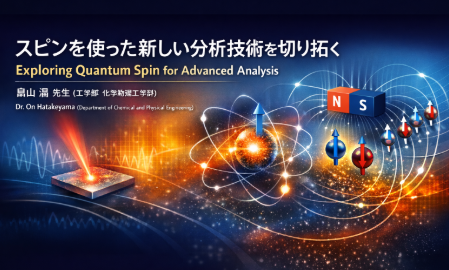
Exploring Quantum Spin for Next‑Generation Analytical Technologies —Interview with Dr. Hatakeyama
Dr. Hatakeyama conducts research in quantum physics, studying the behavior of particles such as electrons and atoms. His work focuses on quantum spin, an intrinsic property of particles, to develop new ultra‑sensitive analytical and measurement techniques.
◆ What Is “Spin”? (For high‑school readers)
Particles in the quantum world possess a built‑in property called spin, which behaves like a tiny magnet.
- Spin never stops — it is an inherent feature of all particles
- Measuring spin reveals what the particle is and its internal state
- Many aligned spins form the magnetism we experience in everyday life
Thus, spin is a key to understanding the nature of matter.
◆ Research Overview: Toward Ultra‑Sensitive Spin‑Based Analysis
If spins can be measured precisely, researchers can detect extremely small amounts of substances or reveal their states with high sensitivity.
However, spin signals are inherently weak. Dr. Hatakeyama’s lab is working to overcome this challenge by combining:
- Laser manipulation
- Electromagnetic field control
- Quantum state engineering
with the goal of enabling spin measurements from tiny samples, paving the way for future quantum sensors, analytical techniques, and precision measurement technologies.
◆ Why Physics? — Dr. Hatakeyama’s Story
His interest in physics began in middle school when a teacher showed him the science magazine Newton. Articles on relativity and quantum mechanics sparked the realization that:
“Physics can explain the mysterious.”
Later, fascinated by the freedom and creativity of academic research, he decided to become a university researcher.
◆ Message to High‑School Students
“University offers freedom and opportunities. Think for yourself, be creative, try hard, and use that freedom to pursue what inspires you.”