日時:10月23日(水)16:30~18:00
場所:BASE棟講義室4(1F、旧会議室)
論文題目:Design of Encapsulated Ni-Based Catalysts for Steam Reforming of Bio-oil Derived (バイオマス由来バイオオイルの水蒸気改質のための内包型Ni系触媒の設計)
PhD candidate: S. Silmina
Meeting
https://tuat-jp.zoom.us/j/82213909799?pwd=cxelxrIpQHrvAF0adWbfzn3rTWTif7.1
Meeting ID: 822 1390 9799
Passcode: 664417
A reference:
https://doi.org/10.1016/j.fuel.2026.141463
Steam reforming of acetic acid over Ni nanoparticle catalysts encapsulated on Al2O3 using cellulose nanofibers (CNFs) as a template: the role of promoter addition
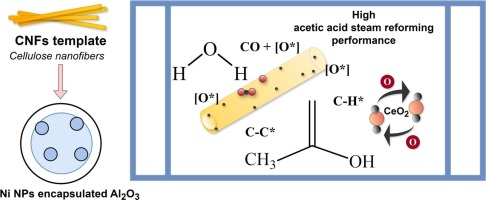
Highlights:
- New design of Ni catalysts was encapsulated on Al2O3 using CNFs as template.
- CNFs addition strongly influenced catalytic steam reforming performance.
- ZrO2, MgO, and CeO2 significantly increased H2 yield with each playing a different role.
- Promoted CNFs-templated Ni NPs catalysts showed improved stability, resisting carbon deposition and sintering.
Abstract
A novel cellulose nanofiber (CNFs)-templated Ni-Al2O3 catalyst was developed to enable efficient steam reforming of bio-oil aqueous-phase components. CNFs derived from sustainable pulp feedstock served as sacrificial structural templates, promoting hierarchical porosity and improving the dispersion of nickel (Ni) nanoparticles (NPs). Optimization of CNFs template addition demonstrated that Ni©0.2Al2O3 (0.2 g) achieved complete acetic acid conversion and a 78.3% H2 yield at 650 °C and 0.1 MPa, surpassing both lower (0.1 g) and higher (0.3 g) CNFs additions. The incorporation of metal oxide promoters (CeO2, MgO, ZrO2) into the optimal Ni©0.2Al2O3 catalyst further increased H2 yield: Ni©0.2Ce-Al2O3 reached 91.0% due to redox-driven oxygen mobility, Ni©0.2Mg-Al2O3 achieved 89.1% as a result of enhanced basicity, and Ni©0.2Zr-Al2O3 attained 89.7% owing to strengthened metal-support interactions. The promoted catalysts maintained complete acetic acid conversion during a 24-hour durability test, with significant carbon balance closure, indicating stable catalytic performance. This enhanced durability is attributed to the selective redirection of carbon deposition toward non-poisoning, support-localized Cβ species (graphitic or filamentous carbon) rather than active-site-blocking Cα (amorphous carbon).