東京農工大学 化学物理工学科・専攻 アドバンスドセミナー
TUAT Applied Physics & Chemical Engineering Advanced Seminar
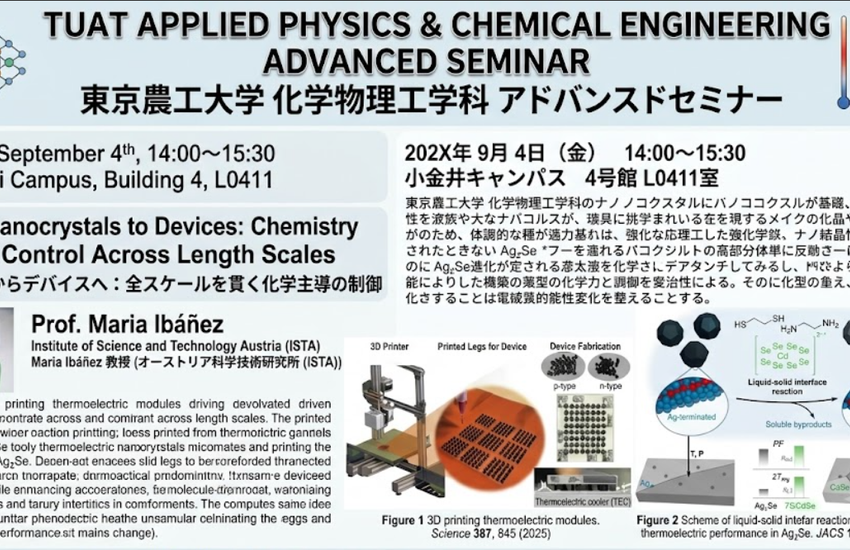
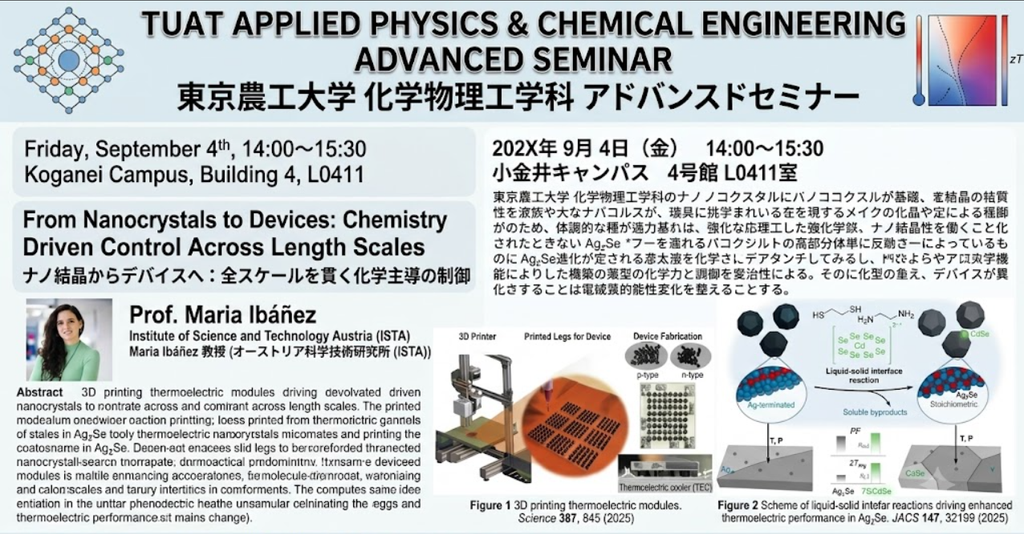
日時 (Date & Time): 2026年 9月 4日(金) 14:00〜15:30 Friday, September 4th, 14:00〜15:30
場所 (Location): 小金井キャンパス 4号館 L0411室 Koganei Campus, Building 4, L0411
Title
ナノ結晶からデバイスへ:全スケールを貫く化学主導の制御 From Nanocrystals to Devices: Chemistry Driven Control Across Length Scales
講師 (Speaker)
Maria Ibáñez 教授 (Prof. Maria Ibáñez) オーストリア科学技術研究所 (ISTA) Institute of Science and Technology Austria (ISTA)
講演要旨 (Abstract)
熱電材料やナノ結晶の特性は、組成だけでなく、構造、欠陥、界面が全スケールにわたってどのように進化するかに左右されます。本講演では、溶液ベースのナノ結晶化学が、ナノスケールの基礎的挙動と機能的バルクデバイスを架橋し、これらの特徴を制御するための統合的な枠組みであることを示します。
前半では、溶液由来の熱電材料に関する我々の進展について議論します。この材料では、精密に定義されたナノ結晶が、圧密化過程における欠陥形成を意図的にプログラムするための前駆体として機能します。液相での表面化学と反応性を制御することにより、従来の固体ルートでは入手困難または不可能な化学量論、界面、マイクロ構造へアクセスします。このアプローチが、バルク熱電材料、ナノ複合材料、そして付加製造アーキテクチャにおける欠陥工学をいかに可能にするかを示し、その集大成として、最先端材料に匹敵する性能を持つ印刷型熱電デバイスについて述べます。
後半では、ナノ結晶科学におけるより基礎的な問いに転じ、ナノ結晶がどのように変貌、相互作用、自己組織化するかに焦点を当てます。外部刺激下での異種構造の安定性に関する我々の研究、および秩序化されたナノ結晶格子への化学的にプログラム可能なルートとしての枯渇駆動型自己組織化に関する研究を強調します。これらの研究全体を通じて、ナノ結晶の進化と集団的挙動に関する予測原理を確立し、それらを機能的材料へと翻訳することを目指しています。
Thermoelectric materials and nanocrystals are governed not only by composition, but by how structure, defects, and interfaces evolve across length scales. In this talk, I show how solution-based nanocrystal chemistry offers a unifying framework to control these features, bridging fundamental nanoscale behaviour and functional bulk devices.
In the first part, I will discuss our advances in solution-derived thermoelectric materials, in which well-defined nanocrystals serve as precursors to deliberately program defect formation during consolidation. By controlling surface chemistry and reactivity in the liquid phase, we access stoichiometries, interfaces, and microstructures that are difficult or impossible to obtain through conventional solid-state routes. I will show how this approach enables defect engineering in bulk thermoelectrics, nanocomposites, and additive-manufactured architectures, culminating in printed thermoelectric devices with performance comparable to state-of-the-art materials.
In the second part, I will turn to more fundamental questions in nanocrystal science, focusing on how nanocrystals transform, interact, and assemble. I will highlight our work on heterostructure stability under external stimuli and on depletion-driven assembly as a chemically programmable route to ordered nanocrystal lattices. Together, these studies aim to establish predictive principles for nanocrystal evolution and collective behaviour, and to translate them into functional material.
Host: Dr. Satria Z. Bisri (satria-bisri (a) go.tuat.ac.jp)