🧲この研究のポイント 3つの要点
✅何を調べたか?
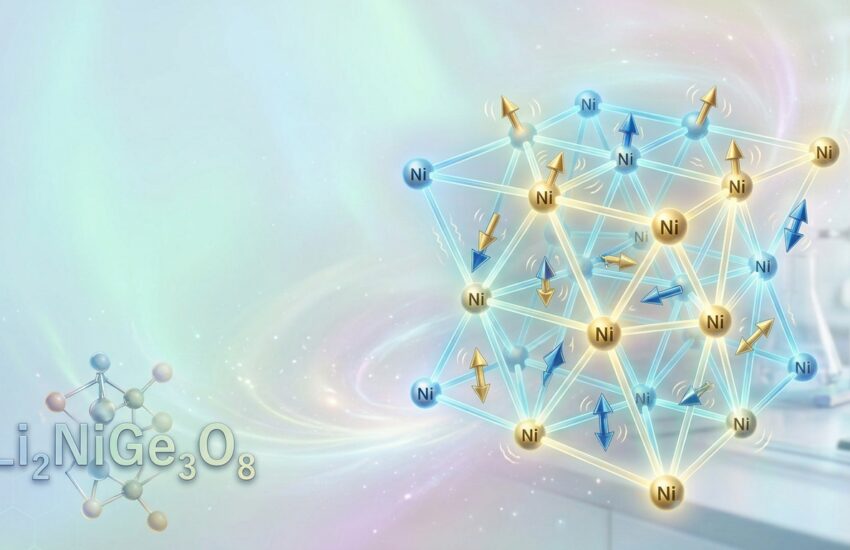
磁石の向きがお互いに邪魔し合って決められなくなる、ジャングルジムのような立体構造(トリリウム格子)を持つ新しい酸化物(Li₂NiGe₃O₈)を合成して調べました。
✅何がわかったのか?
温度を下げても磁石の向きが一斉に揃ってカチッと固まるのではなく、広い温度範囲でお互いの向きを気にしながらじわじわと状態が変化していく不思議な様子(磁気的相関)が確認されました。
✅どうして大切なのか?
これまで理論(計算)の中で考えられていた複雑な磁石のモデルと、実際の物質の性質を比較して検証できる貴重な材料(酸化物)になることが示されました。
🧲1. 背景
N極とS極を持つ小さな「原子の磁石」が集まると、ふつうは温度を下げたときに全員がルールに従ってきれいに並びますが、原子の配置によっては「隣の磁石とどっちを向けばいいのか決められない」という困った状態(物理学で「フラストレーション(葛藤)」と呼びます)が起こります。このような現象が起きる珍しい立体構造「トリリウム格子」は、これまで主に金属で研究されてきました。
しかし、電気を通さない「酸化物(セラミックスのような材料)」で調べることで、よりシンプルに磁石の性質を理論や計算モデルと比較できるようになると期待されていました。
🧲2. 調べたことと結果
本研究では、ニッケル(Ni)を含む新しい酸化物(Li₂NiGe₃O₈)の粉末を作り、その結晶構造や磁気の性質を測定しました。
🔳形の確認: X線を使った測定により、ニッケル原子がきれいな「トリリウム格子」の形に並んでいることが確認されました。
🔳磁化率の測定: 温度を約 -263 ℃(10 K)近くまで下げていくと、平均的な磁場はゼロに近くても、磁石どうしがお互いの向きをゆっくり気にし始める(相関を持つ)様子が観測されました。
🔳熱の伝わり方(熱容量): 普通の磁石のように特定の温度で急激に変化して固まるのではなく、約 -270 ℃(3 K)を中心とした広い温度範囲で、だんだんと状態が変化していく(ブロードなピークを示す)ことが確認されました。
🧲3. この研究が示す意味(論文の範囲内で)
実験の結果から、Li₂NiGe₃O₈ は「トリリウム格子」という特殊な構造の中で、磁石の向きがお互いに影響し合う性質(フラストレーション)を示す数少ない酸化物であることが確認されました。
このデータは、理論物理学で考えられてきた「等方的な(特定の向きを持たない)磁石モデル」と「異方的な(特定の向きを好みやすい)磁石モデル」のちょうど中間に位置するような性質を示しています。完全に理論通りの状態になっているかを確かめるためには、さらに低い温度(-271 ℃以下)での測定や、より細かいミクロな観察実験が必要であると示唆されています。
https://doi.org/10.7566/JPSJ.95.074703
🧲Key Points
✅What was studied?:
Researchers synthesized a new oxide material (Li₂NiGe₃O₈) with a unique 3D structure called a
“trillium lattice,” where atomic magnets interfere with each other and cannot easily choose a direction.
✅What was found?:
As the temperature dropped, the atomic magnets did not abruptly lock into a fixed order. Instead, they gradually influenced each other over a wide temperature range.
✅Why is it important?:
This material provides a rare real-world oxide platform to compare and test theoretical models of
complex magnetic behavior.
🧲1.Background
When tiny atomic magnets are arranged in specific geometric patterns, they often struggle to choose which direction to point—a phenomenon known as “magnetic frustration.” A specific 3D network called a “trillium lattice” induces strong frustration. While mostly studied in metallic systems, exploring this behavior in insulating oxides makes it easier to compare experimental results directly with theoretical physics models.
🧲2.Experiments and Results
The research team synthesized polycrystalline samples of Li₂NiGe₃O₈ and measured its crystal structure, magnetization, and heat capacity.
🔳Structural Analysis: X-ray measurements confirmed that nickel ions form a clean trillium network within an ordered-spinel structure.
🔳Magnetization: Below approximately 10 K (-263 °C), the material showed clear signs of short-range magnetic interactions, even though the net exchange field averaged out to nearly zero.
🔳Heat Capacity: Instead of a sharp transition seen in ordinary magnets, the magnetic heat capacity displayed a broad maximum centered near 3 K (-270 °C), indicating a gradual change in state over a wide temperature range.
🧲3.Implications
Li₂NiGe₃O₈ is a rare example of a single-trillium oxide that displays broad frustrated magnetic correlations.These bulk thermodynamic results place the material between two major theoretical frameworks (Heisenberg-like and spin-ice-like models). Further experiments at lower temperatures (below 2 K) and microscopic probes will be needed to fully clarify its underlying low-temperature state.
本記事は、公開済み論文に基づき学科広報用に編集した紹介文です。This article is an outreach-style summary prepared for the department website based on the published paper.