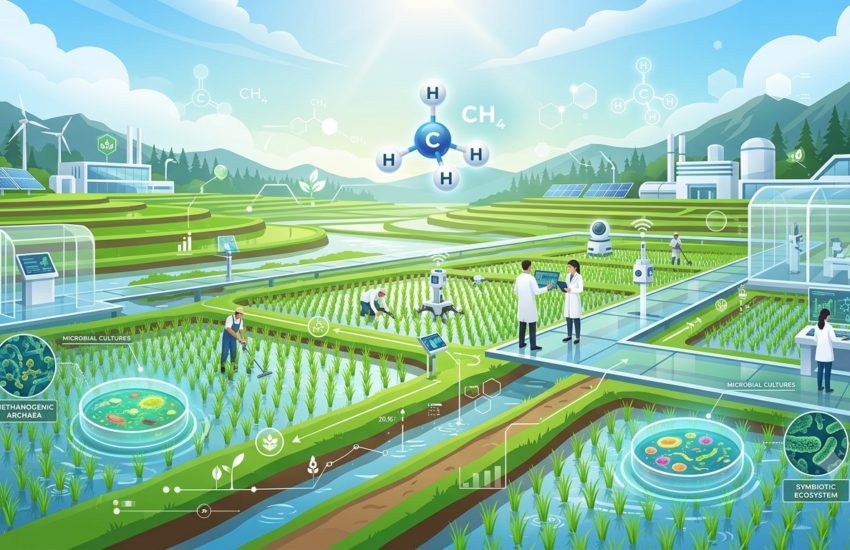
温室効果ガスのメタンを「食糧(タンパク質)」に変える!?水田にすむ微生物たちの驚くべき連携プレー(共生)を解明し、持続可能なタンパク質生産の道を拓く最新研究を紹介します。 Turn greenhouse gases into food! Discover how the synergistic “co-culture” of microbes from rice paddies is paving the way for next-generation, sustainable protein production.
背景と問題意識
強力な温室効果ガスであるメタン(CH4)は、稲作期間中に水が張られた水田などから多く排出されます。一方で、酸素とメタンが交わるイネの根の周辺には、メタンを分解して生育するメタン酸化細菌などの微生物が活発に活動する環境が存在します。近年、これらの微生物を利用して、メタンを動物飼料などの代替タンパク質源となる「シングルセルプロテイン(SCP)」へ変換する技術が、環境保護や持続可能なタンパク質生産の観点から注目されています。しかし、より効率的な生産につながる微生物どうしの相互作用や、生産量を高めるための具体的な要因については、まだ十分に解明されていませんでした。
研究の工夫と新しい点
本研究では、多様な微生物が存在する水田の土壌やイネの根を異なる環境(イネの品種、施肥の有無、微小生息環境など)から採取し、メタンと酸素を供給して微生物群集を濃縮する連続培養実験が行われました。分析の結果、タンパク質の含有量には接種源となったイネの根の違いよりも、培養の段階(逐次培養)がより大きな影響を与えることが見出されました。さらに、微生物の遺伝子などを解析したところ、主に「Methylomonadaceae科」と「Methylophilaceae科」という2つの微生物グループが重要な役割を果たしていることが特定されました。なかでも、メタノールを酸化するMethylophilaceae科の存在量と、バイオマス中のタンパク質含有量(最大20%)との間には、強い正の相関関係(ピアソン相関係数 0.8より大きい、p < 0.05)があることが確認されました。
まとめ
今回の研究結果により、メタン酸化細菌であるMethylomonadaceae科と、メタノール酸化細菌であるMethylophilaceae科を共培養するアプローチの有効性が示されました。存在量の多いMethylophilaceae科が、メタン酸化の過程で生じるメタノールを介してMethylomonadaceae科と相互作用することで、全体のタンパク質収量を向上させられる可能性が示唆されています。本研究の知見は、外部の産業的な炭素源に依存せず、メタンを利用して持続可能にシングルセルプロテインを生産するための、菌群の濃縮条件の最適化に向けた基礎的な基盤となることが期待されます。
10.1016/j.biortech.2025.132397 Full Article
Background and Objectives
Methane (CH4) is a potent greenhouse gas, and flooded rice paddies are major sources of its emission. However, the interface around rice roots where oxygen and methane meet creates a habitat for methane-oxidizing bacteria (methanotrophs). Recently, using these microorganisms to convert methane into single-cell protein (SCP)—an alternative protein source for food and animal feed—has attracted attention from environmental and sustainability perspectives. Nevertheless, the specific factors that enhance production and the synergistic interactions among microbes within these communities have not been fully understood.
Methodology and Findings
In this study, microbial communities were collected from various environments in rice paddies (including different rice cultivars, fertilization conditions, and microhabitats like roots versus soil) and subjected to continuous cultivation with a supply of CH4 and O2. The results revealed that the protein content was primarily influenced by the cultivation stage rather than the source of the rice root inoculum. Genetic and transcriptional analyses identified that the families Methylomonadaceae and Methylophilaceae played dominant roles. In particular, while the methane-oxidizing Methylomonadaceae showed high transcriptional activity, the abundance of the methanol-oxidizing Methylophilaceae was strongly and positively correlated with the total protein content, which reached up to 20% (Pearson’s correlation coefficient greater than 0.8, p < 0.05).
Significance of the Study
The findings demonstrate the potential effectiveness of co-culturing Methylomonadaceae and Methylophilaceae for SCP production. It is suggested that increasing the abundance of Methylophilaceae in a mixed culture system could improve protein yields, likely through methanol-mediated interactions with Methylomonadaceae. This study provides a foundational basis for optimizing enrichment conditions to achieve sustainable SCP production from methane without relying on external industrial carbon sources.
本記事は、公開済み論文に基づき学科広報用に編集した紹介文です。This article is an outreach-style summary prepared for the department website based on the published paper.
202607j.n