🌞 Why Heat Storage Matters/ なぜ蓄熱が重要なのか
Renewable energy like solar and wind is clean and sustainable—but it doesn’t always produce energy when we need it. When the sun goes down or the wind stops, how can we keep supplying heat?
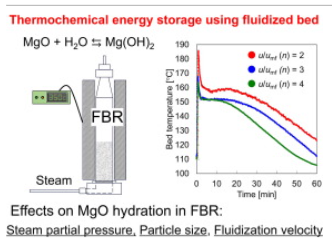
One promising solution is Thermochemical Energy Storage (TCES). Fushimi Lab research explores how magnesium oxide (MgO) particles can store and release heat efficiently using a device called a fluidized bed.
🌞
太陽光や風力のような再生可能エネルギーには、「必要なときに必ず得られるわけではない」という弱点があります。
では、日が沈んだり風が止まったとき、どうやって熱を確保するのでしょうか。
その答えの一つが 化学蓄熱(TCES) です。本研究では、酸化マグネシウム(MgO)を用い、流動層 という装置で効率的に熱を蓄え、必要なときに取り出す仕組みを調べました。
🔬 The Science Behind It: A Reversible Reaction 仕組み:シンプルな可逆反応
The system is based on a simple reversible reaction: この技術は次の可逆反応に基づいています:
To store heat (charging):
We heat magnesium hydroxide to drive off water vapor.
To release heat (discharging):
We add steam to MgO, triggering an exothermic reaction that instantly releases heat.
蓄熱(チャージ):
水酸化マグネシウムを加熱し、水蒸気を飛ばします。
放熱(ディスチャージ):
酸化マグネシウムに水蒸気を与えると発熱反応が起こり、瞬時に熱が取り出せます。
🌪️ Why Use a Fluidized Bed?なぜ「流動層」が有効なのか?
In a traditional fixed bed (like sand in a container), heat moves slowly.
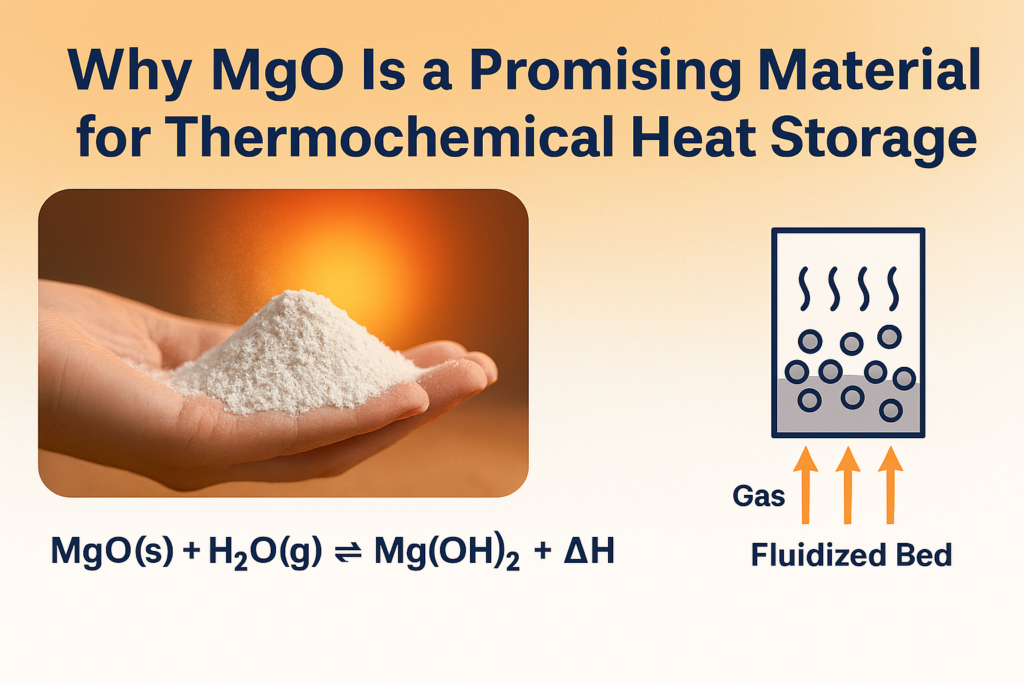
A fluidized bed blows gas from below so particles “dance,” resembling boiling water.
This allows extremely fast heat and mass transfer—ideal for TCES.
固定層では熱の伝わりが遅く、蓄熱材全体を効率よく使えません。
一方、流動層では下からガスを吹き込み、粒子を液体のように動かすため、
熱と物質の移動が非常に速くなります。TCESに最適な方式です。
🔎 Key Results from Experiments
🔥 1. Steam concentration matters
Higher steam ratios (up to 90%) significantly increased the discharge temperature.
🌀 2. “Slower is better” for gas flow
Lower gas velocity resulted in higher outlet temperatures because the steam stayed in contact with particles longer.
⚙️ 3. Optimal operating conditions
- Particle size: 250–500 µm
- Inlet temperature: 110 °C
These conditions produced the most efficient heat release.
🔎 研究でわかった3つのポイント
🔥 1. 高い水蒸気濃度が有利
水蒸気の割合を高めるほど(最大90%)、高温の熱を取り出せました。
🌀 2. ガス流速は「ゆっくり」が効率的
流速を低くすると、粒子と水蒸気が長く接触し、出口温度が上昇しました。
⚙️ 3. 最適な運転条件
- 粒子径:250〜500 µm
- 入口温度:110 ℃
これらが最も効率よく熱を放出できる条件でした。
🧱 Future Challenges
MgO is abundant and safe, but after many cycles its performance gradually decreases.
Particles become finer, and the peak discharge temperature drops slightly.
Our next goal is to develop more durable materials to enable large-scale, long-term TCES systems.
🧱 今後の課題
MgO は安価で安全ですが、繰り返すうちに少しずつ性能が低下します。
粒子が細かくなり、放熱温度のピークも少し下がります。
今後はこの耐久性を改善し、長期間・大規模の蓄熱に耐える材料設計を目指します。
https://doi.org/10.1016/j.apt.2025.105125
Advanced Powder Technology (2025) Thermochemical heat storage performance of MgO/Mg(OH)2 particles in a fluidized bed (Naoya Shirota, Masahiro I. Aoki, Takuto Aoki, Chihiro Fushimi)