From 2027 TUAT University Guide Book
[木材を蒸発器として海水から淡水を生成する!]植物は「毛管力」によって水を吸い上げ、各器官に栄養を運び、蒸散のよって体温を調節するなど優れた生命維持機能を持っています。これらの仕組みを応用し、木材を蒸発器として活用して、身近な自然素材から淡水を得る新しい技術の可能性を探っています。具体的には、電気を使わずに太陽光の熱だけを利用して海水から淡水を生成する蒸発器を開発しています。
この蒸発器の新規性は、木材の表面を「炭化」させることで黒くし、太陽光の幅広い波長を効率よく吸収し、熱を制御する仕組みにあります。農学的な植物の専門知識と炭化という工学的なアプローチを融合した研究になります。
化学物理工学科の魅力は、化学工学と物理工学の視点を同時に得られることです。これは知識の領域をラボスケールからプラントスケールへと展開する際に大きな力になります。この学科は、社会課題の解決に関心のある学生が多く、環境負荷軽減や再生可能エネルギーに関する熱い議論ができるところも気に入っています。
https://www.tuat.ac.jp/english/admission/nyushi_gakubu/digital_pamphlet
https://www.d-pam.com/tuat/2615729/index.html?tm=1#target/page_no=35
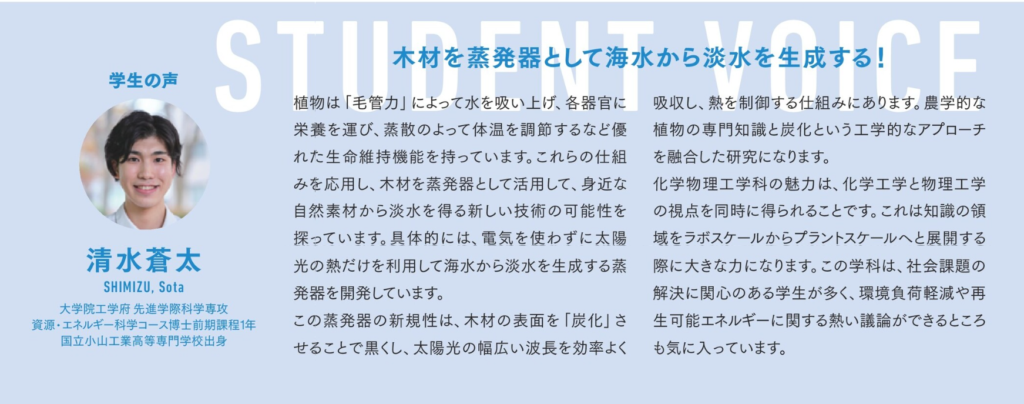
Plants have excellent life-sustaining functions, such as drawing water upward through capillary action, transporting nutrients to each organ, and regulating temperature through transpiration. Inspired by these mechanisms, my research explores the possibility of using wood as an evaporator to produce fresh water from natural materials readily available around us. Specifically, an evaporation device is being developed that generates fresh water from seawater using only solar heat, without electricity.
The novelty of this evaporator lies in the carbonization of the wood surface, which turns it “black” and allows efficient absorption of a wide range of solar wavelengths. This enables effective control of heat. The study integrates plant science knowledge from agriculture with an engineering approach based on carbonization.
One of the strengths of the Department of Applied Physics and Chemical Engineering is the ability to gain perspectives from both chemical engineering and physical engineering. This becomes a powerful advantage when extending knowledge from the laboratory scale to the plant scale. The department also brings together many students interested in solving societal challenges, creating an environment where lively discussions on environmental impact reduction and renewable energy can take place.
From: 2026 TUAT University Guide Book
documents/tuat/admission/nyushi_gakubu/digital_pamphlet/2026_TUAT_GUIDE_HP.pdf
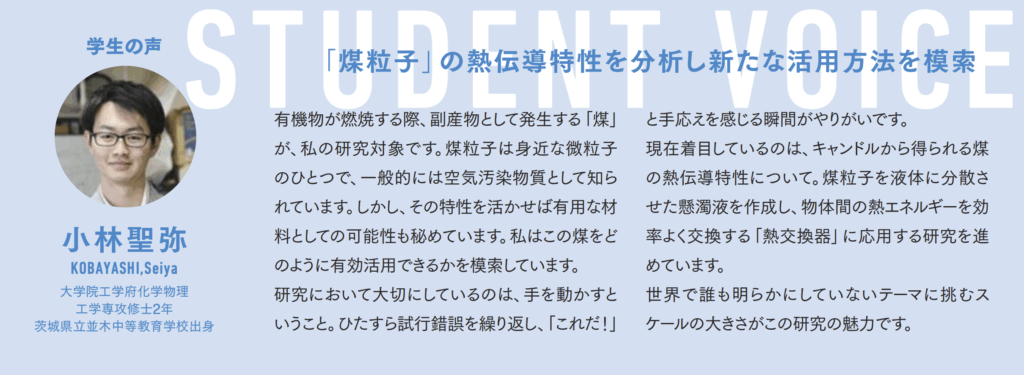
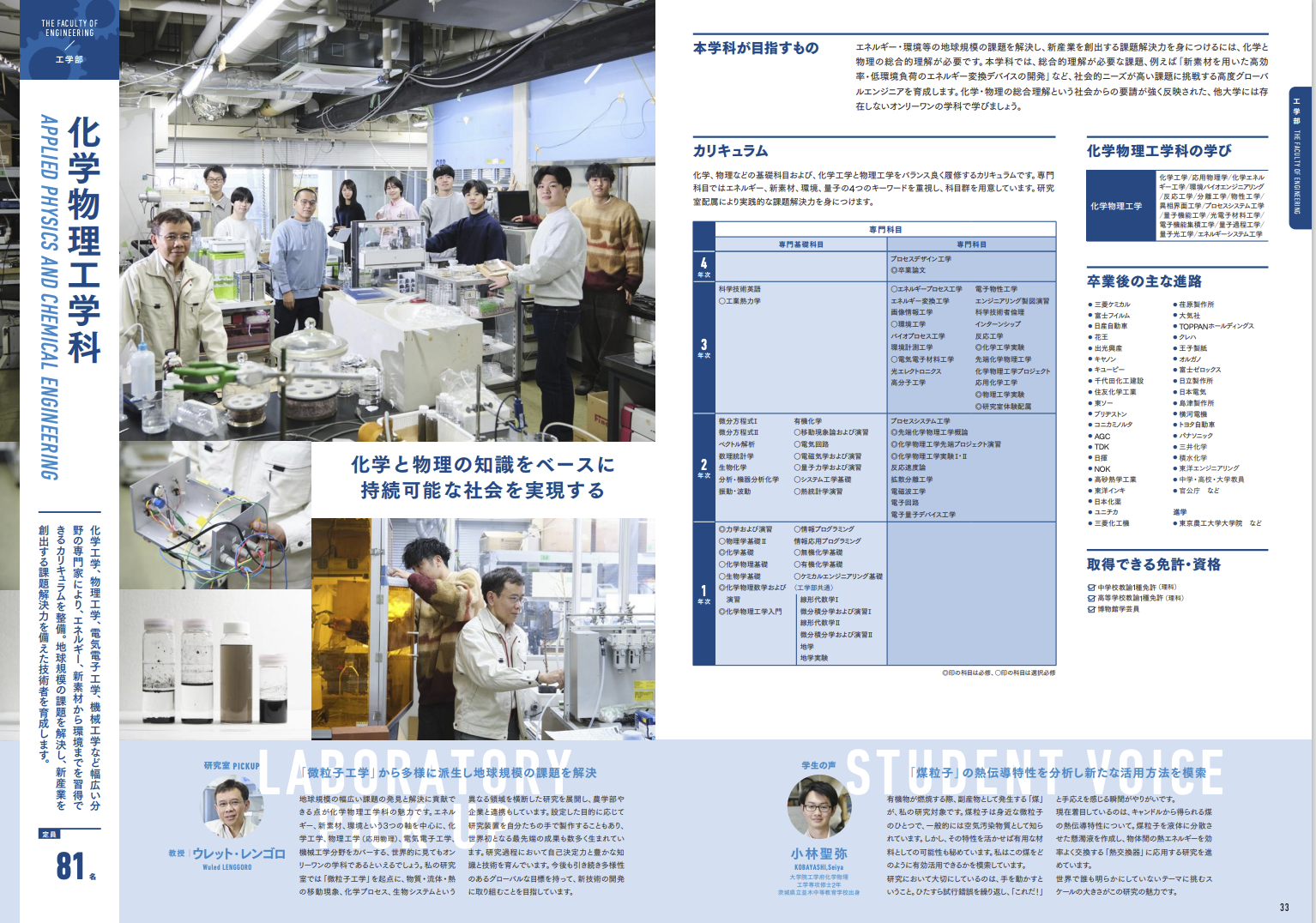
Interview with a Graduate Student (Seiya Kobayashi):
「煤粒子」の熱伝導特性を分析し新たな活用方法を模索
有機物が燃焼する際、副産物として発生する「煤」が、私の研究対象です。煤粒子は身近な微粒子のひとつで、一般的には空気汚染物質として知られています。しかし、その特性を活かせば有用な材料としての可能性も秘めています。私はこの煤をどのように有効活用できるかを模索しています。
研究において大切にしているのは、手を動かすということ。ひたすら試行錯誤を繰り返し、「これだ!」と手応えを感じる瞬間がやりがいです。
現在着目しているのは、キャンドル等から得られる煤の熱伝導特性について。煤粒子を液体に分散させた懸濁液を作成し、物体間の熱エネルギーを効率よく交換する「熱交換器**」に応用する研究を進めています。
世界で誰も明らかにしていないテーマに挑むスケールの大きさがこの研究の魅力です。
「熱交換器**」はほとんど自作
“Analyzing the Thermal Conductivity Properties of Soot Particles and Exploring New Applications”
The research focuses on analyzing the heat conduction properties of “soot particles,” which are produced as a byproduct when organic materials burn. Soot particles are tiny particles familiar in everyday life and are usually known as air pollutants. However, they also have potential as useful materials if their properties are effectively used. I am exploring how to make “good use” of these soot particles.
In research, what is important is to keep working with your hands. The challenge and reward come from repeating trial and error until you feel the moment of “This is it!”
Currently, I am focusing on the heat conduction properties of soot collected from candles and other organic materials. I create a suspension by spreading soot particles in a liquid and study how to apply this to “heat exchangers” (hand-made mainly), which efficiently transfer heat energy between objects.
The big scale of challenging a theme that no one in the world has clarified is what makes this research exciting.
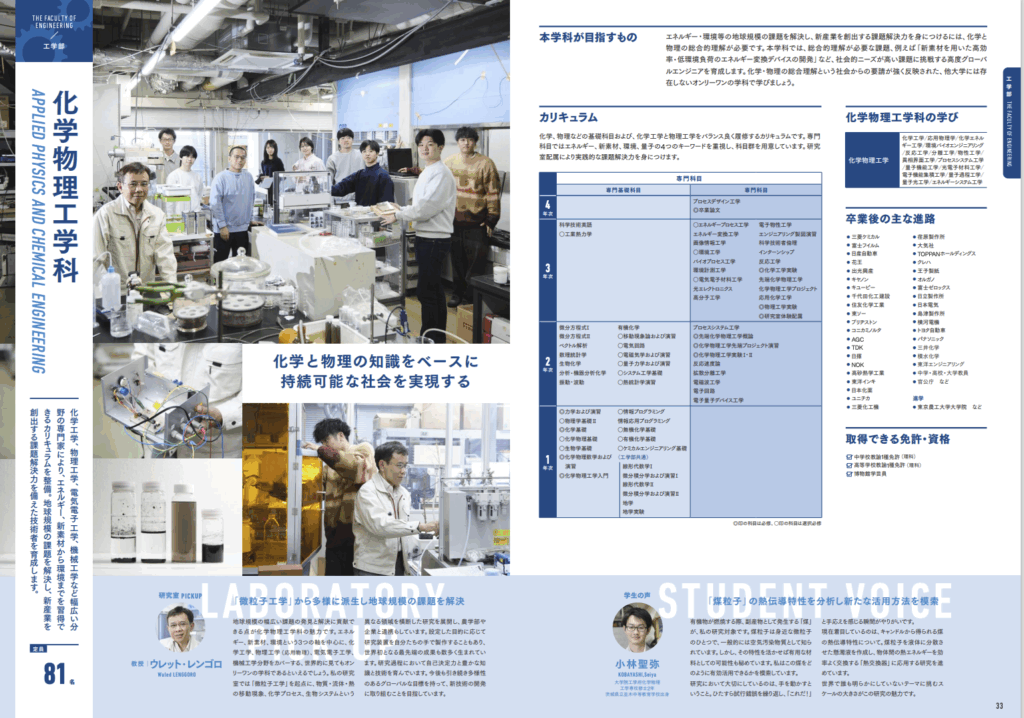
Lenggoro Lab レンゴロ研究室の紹介
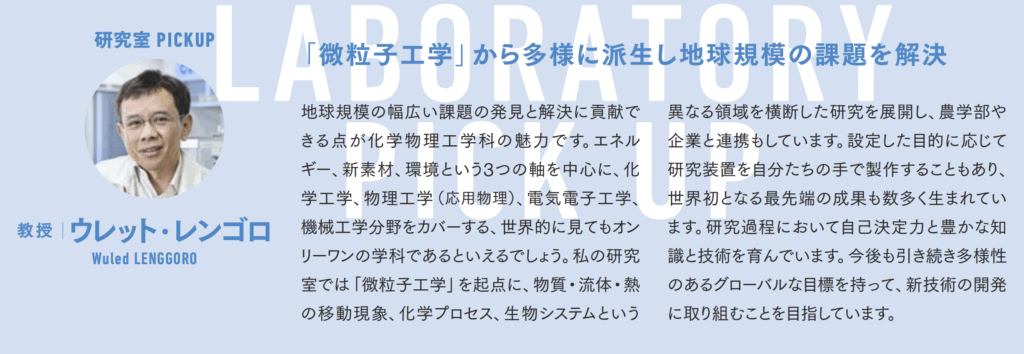
「微粒子工学」から多様に派生し地球規模の課題を解決
地球規模の幅広い課題の発見と解決に貢献できる点が化学物理工学科の魅力です。エネルギー、新素材、環境という3つの軸を中心に、化学工学、物理工学(応用物理)、電気電子工学、機械工学分野をカバーする、世界的に見てもオンリーワンの学科であるといえるでしょう。私の研究室では「微粒子工学」を起点に、物質・流体・熱の移動現象、化学プロセス、生物システムという異なる領域を横断した研究を展開し、農学部や企業と連携もしています。設定した目的に応じて研究装置を自分たちの手で製作することもあり、世界初となる独創的な成果も数多く生まれています。研究過程は自己決定力と豊かな知識と技術を育んでいます。今後も引き続き多様性のあるグローバルな目標を持って、新技術の開発に取り組むことを目指しています。(レンゴロ教授)
From “Particle Engineering” to Diverse Applications: Tackling Global Challenges
One of the great strengths of the Department of Applied Physics and Chemical Engineering is its ability to contribute to the discovery and solution of wide-ranging, global-scale challenges. With a focus on three main pillars—energy, advanced materials, and the environment—the department uniquely integrates chemical engineering, applied physics, electrical and electronic engineering, and mechanical engineering. In fact, it can be considered a one-of-a-kind program, even from a global perspective.
In my research group, we start from particle engineering as a foundation and extend our research across diverse domains such as transport phenomena of matter, fluids, and heat, chemical processes, and biological systems. We also collaborate with the Faculty of Agriculture as well as with industry partners. Depending on the objectives we set, we sometimes design and build our own experimental equipment, which has led to many original, world-first results.
The research process itself fosters strong decision-making skills along with a rich base of knowledge and technical expertise. Looking ahead, we will continue to pursue the development of new technologies with diverse and global goals in mind. (Prof. Wuled Lenggoro)
From: University Guide Book 2026
https://www.tuat.ac.jp/english/admission/nyushi_gakubu/digital_pamphlet/